Article
Natural childbirth today
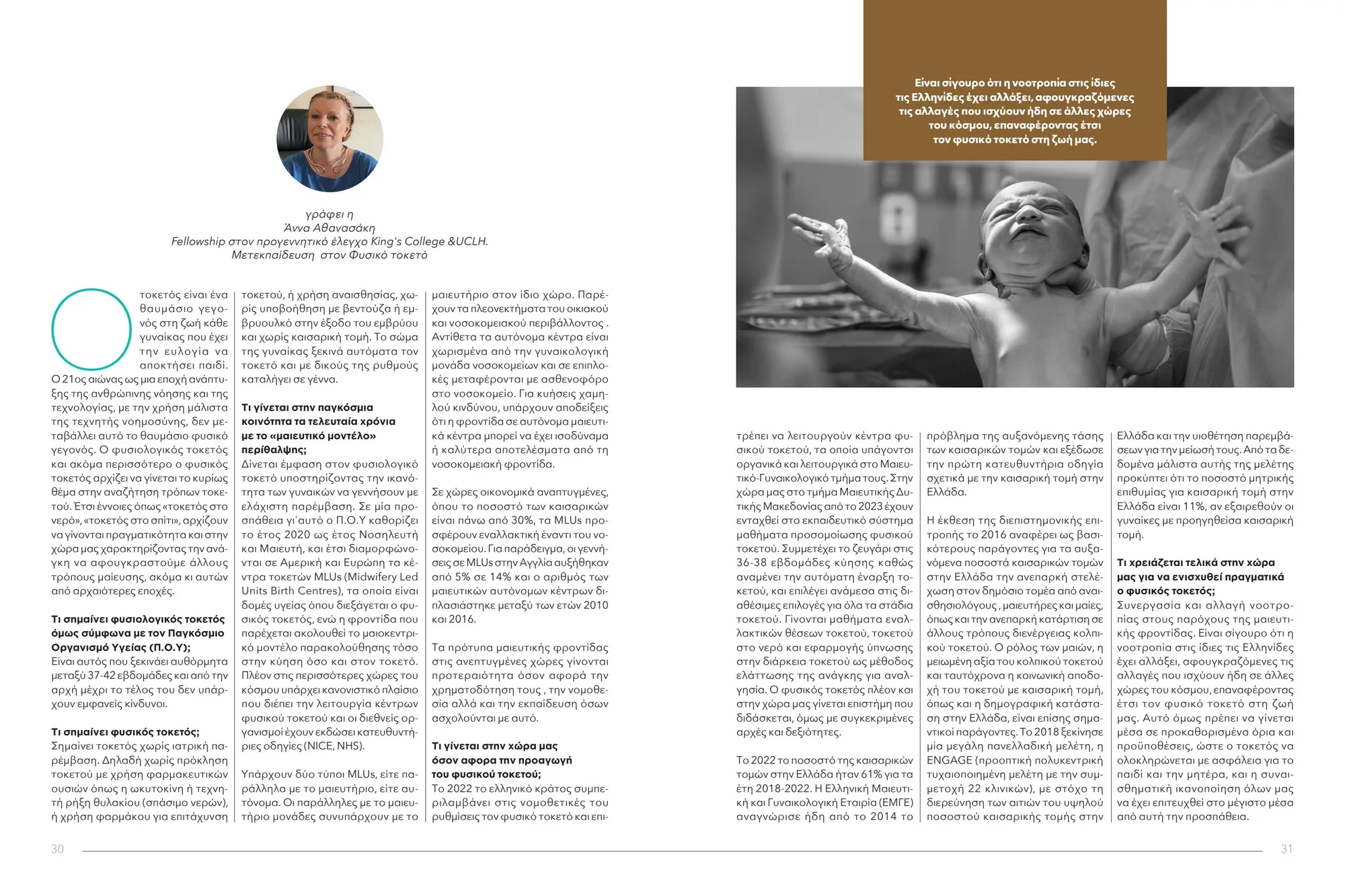
Natural childbirth is beginning to become the central subject in the search for ways of giving birth.
Childbirth is a wonderful event in the life of every woman who has the blessing of having a child. The 21st century, as an era of the development of human thought and of technology, with the use of artificial intelligence too, does not alter this wonderful natural event. Normal childbirth, and even more so natural childbirth, is beginning to become the central subject in the search for ways of giving birth. Thus concepts such as «water birth» and «home birth» are beginning to become a reality in our country as well, reflecting the need to listen to other ways of giving birth, including those of earlier times.
But what does normal childbirth mean, according to the World Health Organization (WHO)?
It is a birth that begins spontaneously between 37 and 42 weeks and in which, from beginning to end, there are no apparent risks.
What does natural childbirth mean?
It means birth without medical intervention. That is, without induction of labour using pharmaceutical substances such as oxytocin, or artificial rupture of the membranes (breaking the waters), or the use of drugs to accelerate labour, or the use of anaesthesia, without assistance from a ventouse or forceps as the baby is delivered, and without a caesarean section. The woman's body begins labour on its own and, at her own rhythm, brings it through to birth.
What has been happening internationally in recent years with the «midwifery model» of care?
Emphasis is placed on normal childbirth, supporting women's ability to give birth with minimal intervention. As part of this effort, the WHO designated 2020 as the Year of the Nurse and the Midwife, and so MLU birth centres (Midwifery Led Units) were established in America and Europe: health facilities where natural childbirth takes place, and where the care provided follows the midwife-led model of monitoring, both during pregnancy and during the birth. In most countries of the world there is now a regulatory framework governing the operation of natural birth centres, and international organisations have issued guidelines (NICE, NHS).
There are two types of MLU, either alongside the maternity unit or free-standing. Units alongside the maternity unit share the same premises with it. They offer the advantages of both a home-like and a hospital environment. Free-standing centres, by contrast, are separate from the gynaecological unit of hospitals and, in the event of complications, women are transferred to hospital by ambulance. For low-risk pregnancies, there is evidence that care in free-standing midwifery centres can have equivalent or better outcomes than hospital care.
In economically developed countries, where the caesarean section rate is above 30%, MLUs offer an alternative to hospital. For example, births in MLUs in England rose from 5% to 14%, and the number of free-standing midwifery centres doubled between 2010 and 2016.
Standards of midwifery care in developed countries are becoming a priority in terms of their funding, their legislation, and also the training of those who work in the field.
What is happening in our country as regards the promotion of natural childbirth?
In 2022 the Greek state included natural childbirth in its legislation and allowed the operation of natural birth centres, which come under the organisational and operational responsibility of their obstetric and gynaecological department. In our country, in the Midwifery Department of Western Macedonia, simulation classes in natural childbirth have been part of the curriculum since 2023. The couple takes part at 36-38 weeks of pregnancy, while awaiting the spontaneous onset of labour, and chooses among the available options for all the stages of birth. There are classes on alternative birthing positions, on water birth and on the use of hypnosis during labour, as a method of reducing the need for analgesia. Natural childbirth is now, in our country too, a science that is taught, but with specific principles and skills.
The caesarean section rate in Greece was 61% for the years 2018-2022. The Hellenic Society of Obstetrics and Gynaecology recognised the problem of the rising trend in caesarean sections as early as 2014 and issued the first guideline on caesarean section in Greece.
The report of the interdisciplinary committee in 2016 identifies as the main factors behind the rising caesarean section rates in Greece the inadequate staffing in the public sector with anaesthetists, obstetricians and midwives, as well as insufficient training in other ways of conducting a vaginal birth. The role of midwives, the diminished value placed on vaginal birth and at the same time the social acceptance of birth by caesarean section, as well as the demographic situation in Greece, are also significant factors.
In 2018 a large nationwide study began, ENGAGE (a prospective multicentre randomised study with the participation of 22 clinics), aiming to investigate the causes of the high caesarean section rate in Greece and to adopt interventions to reduce it. The data from this study indicate that the rate of maternal request for caesarean section in Greece is 11%, if women with a previous caesarean section are excluded.
What is ultimately needed in our country for natural childbirth to be genuinely supported?
Cooperation and a change of mindset among the providers of maternity care. It is certain that the mindset of Greek women themselves has changed, as they take in the changes already in place in other countries of the world, thus bringing natural childbirth back into our lives. This, however, must take place within predefined limits and conditions, so that the birth is completed safely for the child and the mother, and so that the emotional satisfaction of all of us is achieved to the fullest through this effort.